
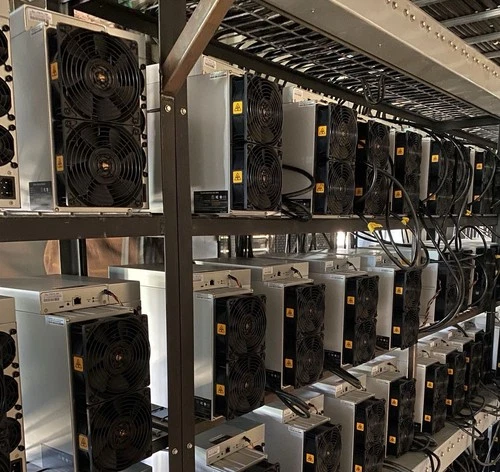
Refurbishing fixes the things that wear — fans, thermal interface, power supplies, connectors, dust — and it fixes nothing about the thing that actually ends a miner’s life. Which parts fail, what the replacements cost and when a board is not worth saving is the subject of used vs new ASIC miners. Silicon does not lose efficiency with age. A machine that did 95 TH/s for 3,250 W when new does roughly the same years later; what changed is that difficulty rose and better hardware arrived, so the same output earns less.
That is the honest case for refurbished hardware and also its limit: you are buying working capacity cheaply, not buying back the margin a newer machine has. Where that trade lands is worked through in how to buy a used ASIC miner, and what “refurbished” commits us to across a batch rather than a single machine is on bulk used ASIC miners.
What Refurbished ASIC Miners Really Are
Refurbished ASIC miners aren’t mysterious devices. They’re used mining computers that have been professionally cleaned, repaired, tested, and restored to working condition.
Here’s the critical distinction: refurbished does not mean “broken and patched together.” It means a unit has completed a lifecycle—whether from a data center, large mining farm, or individual operator—and has been systematically brought back to functional specifications.
The Refurbishment Process
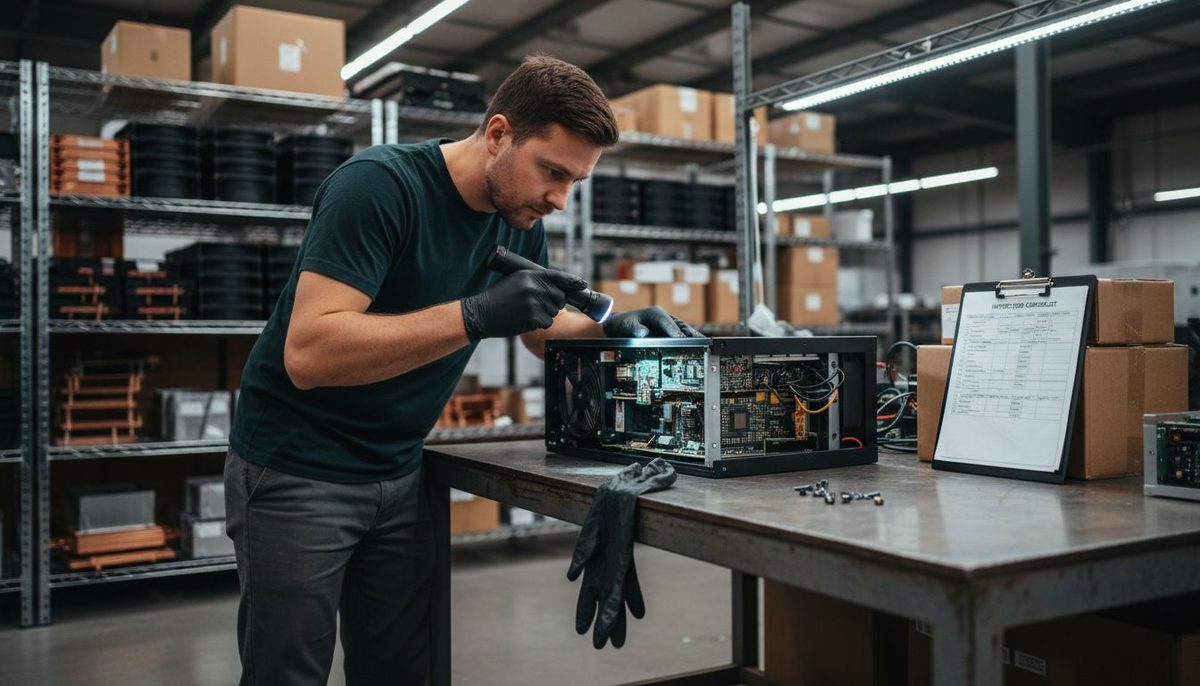
When a miner arrives at a refurbishment facility, it undergoes several stages:
- Visual inspection: Technicians examine the unit for physical damage, corrosion, or component wear.
- Component testing: Critical parts (power supplies, circuit boards, cooling systems) are tested under load to verify performance.
- Cleaning: Accumulated dust and thermal paste residue are carefully removed from heat sinks and fans.
- Software verification: The miner runs diagnostic tests to confirm it achieves its rated hash rate.
- Thermal assessment: Engineers verify the unit operates within acceptable temperature ranges.
Why Miners End Up Refurbished
ASIC miners don’t fail catastrophically and disappear. They age through normal operation. Farms replace units when newer, more efficient models arrive. Individual miners upgrade their setups. Power supplies degrade. Fans wear out. None of these issues make a miner worthless—they make it a candidate for refurbishment.
Unlike consumer electronics where “refurbished” sometimes carries stigma, refurbished miners have a clear operational history. You’re not buying a mystery box. You’re buying equipment with documented testing results and performance verification.
What Separates Quality Refurbishment
Not all refurbished miners are created equal. This is where specifics matter:
- Testing documentation: Reputable operations provide hash rate verification and stability test results, not vague assurances.
- Replacement parts: Worn components (capacitors, fans, thermal paste) are replaced, not reused.
- Warranty period: A real warranty reflects confidence in the restoration quality.
- Transparency about condition: You should know the miner’s original source, any repairs performed, and realistic lifespan expectations.
When sourcing refurbished ASIC miners, the difference between a properly refurbished unit and a cosmetically cleaned one directly impacts profitability and reliability.
The Real Value Proposition
Refurbished miners cost 40-60% less than new equivalents while delivering identical hash rates. The catch is not hidden defects—it’s understanding lifespan. A refurbished miner might have 2-4 years of useful life remaining, depending on original usage intensity and how well it was maintained during refurbishment.
This is why miners at scale prefer refurbished equipment. The math is straightforward: lower upfront cost plus predictable operational timeframe equals better return per dollar deployed.
Types of Refurbishment and Inspection Processes
Refurbishment approaches vary significantly depending on the miner’s condition, origin, and intended use. Understanding these variations helps you know exactly what you’re purchasing and what performance to expect.
Standard Refurbishment
Standard refurbishment addresses typical wear from operational use. A miner that ran in a controlled data center environment for 18-24 months falls into this category.
The process includes:
- Dust removal: Compressed air and soft brushes clean internal components without damaging circuit board traces.
- Thermal paste replacement: Old, degraded paste is removed and fresh material applied to all heat transfer surfaces.
- Fan inspection and replacement: Bearings wear out. New fans are installed if the original units show noise or reduced airflow.
- Power supply testing: Units are loaded at 80-100% capacity for extended periods to verify stable output and voltage regulation.
- Full hash rate verification: The miner runs test algorithms continuously for 4-8 hours to confirm rated performance.
Deep Refurbishment
Deep refurbishment tackles units with more significant wear or previous damage. These miners may come from high-temperature environments, outdoor installations, or systems that experienced partial failures.
Deep processes include everything in standard refurbishment, plus:
- Component-level repair: Failed capacitors, voltage regulators, or connectors are desoldered and replaced. What gets swapped instead of reworked, and what a swapped board is worth, is in our Antminer parts compatibility guide.
- Board-level testing: Technicians use specialized equipment to identify weak traces or marginal solder joints.
- Extended stability testing: Miners run at elevated ambient temperatures (95-105 degrees Fahrenheit) for 12-24 hours to expose latent defects.
- Partial or full cooling system replacement: If heat sinks are damaged or fans are worn, complete cooling assemblies are swapped.
Cosmetic-Only Refurbishment
This is where quality varies dramatically. Some sellers simply clean the exterior, run a quick 30-minute hash rate test, and call it refurbished. A properly refurbished ASIC miner involves comprehensive internal inspection and component replacement, not surface cleaning.
Cosmetic-only units often fail weeks after purchase due to undetected internal degradation.
Here’s a side-by-side comparison of standard, deep, and cosmetic-only refurbishment approaches:
| Refurbishment Type | Typical Scope | Reliability Outcome | Best Use Case |
|---|---|---|---|
| Standard | Moderate wear, basic repairs | Highly dependable | Recent, well-maintained units |
| Deep | Heavy wear, major repairs | Maximum longevity | Harsh environment recovery |
| Cosmetic-Only | Surface cleaning only | High early failure risk | Budget-oriented, low warranty |
Inspection Standards That Matter
Reputable operations use documented inspection checklists:
- A written note of physical condition — corrosion, fan wear, damaged fins, missing screws — rather than a score out of ten, because a score compresses the one thing you needed told plainly
- Hash rate certification with timestamp and duration
- Power efficiency measurement under load
- Temperature stability verification
- Component-by-component testing results logged and archived
You should receive written documentation for every test. If a seller can’t provide it, the refurbishment wasn’t thorough.
Performance Benefits Versus New and Used Units
Refurbished miners occupy a middle ground between brand-new equipment and unknown used units. Understanding how they compare on performance, reliability, and cost helps you make informed purchasing decisions.
Refurbished Versus Brand-New
New miners arrive with full warranties and zero operational hours. They also cost 80-120% more than refurbished equivalents. A new Antminer S19 Pro runs $2,500-3,200, while a properly refurbished unit delivers identical hash rates for $1,200-1,800.
The trade-off is lifespan expectation. New miners might operate profitably for 4-6 years. Refurbished units typically have 2-4 years of reliable service remaining, depending on their first-life usage intensity.
Performance is identical. Both deliver the same hash rate, power efficiency, and thermal characteristics from day one.
Refurbished Versus Unknown Used
This is where the real distinction matters. Buying a used miner from an unknown seller is a gamble. You get no testing documentation, no component inspection records, and no warranty protection.
Refurbished miners come with:
- Documented testing results: Hash rate verification with timestamps and duration.
- Component replacement: Worn parts are swapped before you receive the unit.
- Warranty period: whatever term is offered should be written on the listing with its start date. We state ours per listing rather than as a store-wide band, because the sensible term on a bench-tested S19 and on a board sold for parts are not the same term.
- Traceability: you know when it was worked on and what it measured afterwards — the hashrate it held and the watts it pulled at the wall, not a grade out of ten.
Unknown used miners lack all of this. You might receive equipment that fails within weeks, with zero recourse.
The Real Performance Comparison
When evaluating advantages of buying used ASIC miners, remember that refurbished units are a specific category of used equipment with professional restoration applied.
Hash rate performance comparison:
- New: the rated figure, and the manufacturer is on the hook if it is not.
- Refurbished: whatever the bench actually measured. That number goes on the listing — a hashrate and a wall draw, not a percentage of a spec sheet.
- Unknown used: unknown. That is not a hedge, it is the definition. Anyone quoting you a percentage of rated spec for a machine they never powered up is guessing, and the guess is always flattering.
Cost and Profitability Analysis
Your profit equation has three numbers in it and the purchase price is the least interesting one. At the hashprice we measured on 10 August 2026 — $31.72 per PH/s per day, derived from a difficulty of 127.48 T and a BTC price of $63,888 rather than read off a dashboard — a 95 TH/s S19 earns $3.01 a day gross. Not $8, and not $12. It burns 78 kWh a day earning it.
That is why the electricity rate decides this and the sticker price does not. At 3¢/kWh the power costs $2.34 and the machine nets 67 cents a day. At 4¢ it is already losing money, and no purchase price rescues it — a machine that does not clear its power bill does not have a payback period, it has a burn rate. A tested S19 here is $159.99 and a tested S19k Pro $379.99, so on cheap power the S19 clears its own cost in roughly eight months and on retail power it never does.
Reliability and Failure Rates
We do not publish a DOA or early-failure percentage — not for refurbished stock and not for used — and you should be wary of any seller who does unless they will show you the batch it was measured over. A failure rate is a measurement across a population: it depends on the model, the age and duty cycle of the fleet the units were pulled from, and how they were packed. One number quoted across all used hardware is marketing, not data.
What is checkable is what was done to the machine in front of you. Was it powered up? What hashrate and wall draw did it hold, and for how long? What happens if it arrives dead? Those belong on the listing, and on a lot they matter more than on a single unit — what you want written down before a pallet ships is the return path for the units that do fail, not the seller’s estimate of how many will.
See how new, refurbished, and unknown used miners compare on key purchasing factors:
| New | Refurbished, tested | Untested used | |
|---|---|---|---|
| What we charge | $4,200 for a current-generation S21 Pro 245T; $1,999 for an Avalon Q | $159.99–$379.99 for a tested S19 or S19k Pro | we do not sell these as machines — untested stock is listed as parts |
| Condition | sealed or factory stock | deep-cleaned, parts replaced as needed, bench-tested before it ships | unknown by definition |
| Warranty | whatever the manufacturer term is, named on the listing with its start date | stated per listing — some carry a term, some state none | none, and any seller offering one on untested stock is guessing |
| What you are actually buying | a known machine and a known term | a measured hashrate and a measured wall draw | a lottery ticket priced like a machine |
Financial Impact and Long-Term Profitability
Refurbished miners shift your profitability equation in measurable ways. Lower upfront costs combined with predictable operational timelines create different financial outcomes than new or unknown used equipment.
The Math of Lower Capital Investment
Capital deployment directly affects your return on investment. A refurbished miner costs 50-60% less than new, freeing capital for additional units or operational expenses.
Compare these scenarios over 30 months:
- New: an S21 Pro 245T is $4,200 here and earns $7.77 a day gross at today’s hashprice, on 88.2 kWh/day. It keeps earning down to about 9.0¢/kWh.
- Refurbished: a tested S19 is $159.99 and earns $3.01 a day gross, on 78 kWh/day. It stops earning at about 3.9¢/kWh.
They do not generate similar daily returns — the new machine earns more than twice as much per day and survives to more than twice the electricity price. What the refurbished unit gives you is a twenty-sixth of the capital at risk per machine. That is a real advantage and it is a different one: it is what lets you find out whether your site, your power contract and your patience actually work before you commit $4,200 a slot.
Revenue Consistency Versus Risk
Refurbished miners come with documented hash rates. You know exactly what performance to expect before deployment. That removes the surprise of buying “used” equipment that turns out to hold a lower hashrate, or pull more at the wall, than the model name implies. How much lower is not something anyone can tell you about a machine nobody switched on — which is the entire point.
Unknown used miners introduce financial uncertainty:
- Unpredictable performance degradation
- No measured failure rate at all, because nobody powered them up
- No warranty protection if units fail
- Unplanned replacement costs
Refurbished units reduce this variance. Testing before shipment means revenue projections are reliable.
Understanding Hardware Depreciation
All ASIC miners depreciate. Mining hardware depreciation affects your long-term financial position whether you purchase new or refurbished equipment. You do not need a depreciation curve from anywhere but this shelf. The S19 was current-generation hardware when it shipped and it is $159.99 here today, next to a current S21 Pro at $4,200. That is the whole depreciation story for an ASIC, and a refurbished machine is one that has already been through it.
Purchasing refurbished means you’ve already absorbed the harshest depreciation hit. Your remaining 2-4 years of operation experience slower value decline.
Operational Lifespan and Breakeven Analysis
Your breakeven point depends on three variables: upfront cost, daily revenue, and electricity expenses. Refurbished miners with their lower entry cost reach profitability faster.
Worked at the hashprice above, on a tested S19 at $159.99 — 78 kWh a day, $3.01 a day gross:
- At 2¢/kWh (behind your own meter, or a good hosting deal): $1.56 power, $1.45 net a day. Breakeven in about 110 days.
- At 3¢/kWh: $2.34 power, 67¢ net a day. Breakeven in about 240 days.
- At 3.9¢/kWh: the power bill equals the revenue. There is no payback at any purchase price.
- At 8¢/kWh — the rate this section used to assume — the machine burns $6.24 of electricity to earn $3.01. It loses $3.23 every day it is switched on.
That last line is why we will not print a payback period without the electricity rate next to it. Buying refurbished shortens the payback on power cheap enough to have one; it cannot create one where the arithmetic says there is none.
Scaling Economics
This is where used stops being a discount and starts being a strategy. Fifty refurbished S19s off this shelf is one lot, and since 11 August 2026 it is quoted rather than listed — so the per-machine number is whatever comes back, and the honest instruction is to ask for it and divide it yourself against the $159.99 we ask for a single one. Fifty new S21 Pro 245Ts is $210,000. That is not a saving, it is a different business — and the constraint moves with it, because those fifty S19s want 162.5 kW of feed to the new machines’ 184 kW, and the S19s need power under 3.9¢/kWh to earn anything at all while the S21s work to 9.0¢. On cheap power the used fleet is the obvious buy. On retail power it is fifty space heaters.
Which is the real question to answer before a lot ships: what does your power actually cost, all-in, at the meter that will feed these? Everything else about the batch is negotiable and that number is not.
Work out your own breakeven before you compare any two machines. Break-even $/kWh is hashprice divided by (24 × the machine’s J/TH), so a 23 J/TH unit stops earning at about 5.8¢/kWh and a 34 J/TH unit at about 3.9¢/kWh. Refurbished versus new only changes how long the payback takes; your electricity rate decides whether there is a payback at all.
Risks, Warranty, and Common Pitfalls to Avoid
Refurbished miners carry real risks that differ from new equipment. Understanding these risks and how warranty protection works prevents costly mistakes and unexpected downtime.
The Warranty Gap
Warranty terms define your financial protection if a miner fails. New equipment typically includes 1-2 year manufacturer warranties. Refurbished miners usually carry 30-90 day seller warranties, not manufacturer coverage.
This matters significantly. If a refurbished miner fails at day 91, you own the repair or replacement cost entirely. Manufacturer defects discovered outside the warranty window become your financial responsibility.
ASIC miner warranty protection should explicitly state what components are covered, the duration of coverage, and whether the seller or manufacturer stands behind the unit.
Early Failure Risk
Refurbished miners show higher early failure rates than new equipment. Units that fail in the first 30-60 days often have underlying issues that didn’t surface during initial testing.
Common early failures include:
- Intermittent power supply issues: Borderline capacitors fail under extended load.
- Fan bearing degradation: Worn bearings seize after days of continuous operation.
- Thermal paste separation: Improperly applied paste degrades under thermal cycling.
- Marginal solder joints: Circuit board connections that tested fine fail under real-world vibration.
This is the failure mode that a short bench run will not catch and a long one will, which is why the run length is worth asking about.
The question to put to any refurbisher, ours included, is not how long the warranty is but what was measured: ask for the hashrate and the wall draw recorded on the bench for the specific unit, and ask for the warranty term in writing for that unit rather than for the catalogue. We state condition and warranty per listing for exactly that reason — a tested working machine and a board sold for parts do not deserve the same sentence.
Hidden Wear and Unknown History
You cannot fully inspect internal components before purchase. A miner that passed testing might have marginal capacitors with only weeks of remaining life. Previous owners may have operated units in harsh conditions—high dust environments, inadequate cooling, or power quality issues—leaving invisible damage.
Unknown history means unknown stress. A miner from a farm running 95+ degree Fahrenheit ambient temperatures ages faster than one from a climate-controlled data center.
Lifespan Uncertainty
Refurbished equipment comes with estimated remaining lifespan, not guaranteed lifespan. A vendor might state “2-3 years of remaining operation,” but this is an estimate based on typical usage patterns.
Your actual lifespan depends on:
- Ambient temperature: Hot environments degrade components faster.
- Power quality: Unstable voltage accelerates capacitor failure.
- Cooling effectiveness: Poor airflow reduces component lifespan.
- Operating duty cycle: 24/7 mining stresses hardware differently than intermittent operation.
A miner estimated for 2 years might last 3 with optimal conditions or fail within 18 months in poor conditions.
Common Purchasing Pitfalls
Avoid these mistakes when sourcing refurbished miners:
- Skipping test documentation review: If sellers can’t provide hash rate verification, failure rates, or component replacement records, don’t buy.
- Assuming cosmetic condition equals functionality: A clean-looking miner may have internal defects invisible to visual inspection.
- Ignoring warranty limitations: Read the fine print. Some warranties exclude damage from power fluctuations or improper cooling.
- Buying from unknown sellers without payment protection: Use escrow or credit cards that offer buyer protection.
- Deploying miners without temperature monitoring: Mining hardware failures often correlate with thermal stress—monitor temperatures from day one.
Due Diligence Questions
Before purchasing, ask vendors these specific questions:
- What was the miner’s original source (data center, farm, individual)?
- How many operational hours did it accumulate?
- Which components were replaced during refurbishment?
- What were the specific hash rate test results and duration?
- What is the warranty period and what does it cover?
- Do you offer return protection if performance doesn’t match specifications?
Legitimate vendors answer these directly with documentation. Vague responses indicate insufficient refurbishment quality.
What we test before a refurbished unit goes on the shelf
Understanding the importance of professional refurbishment can dramatically impact your mining success. The article highlights key challenges such as balancing upfront costs, operational lifespan, and the critical need for thorough testing and warranty coverage. ING Mining addresses these pain points by offering ASIC miners that undergo rigorous inspection, component replacement, and hash rate verification to ensure reliable, near-new performance.
Explore our extensive selection of refurbished ASIC miners backed by transparent test results and seller warranties. With ING Mining, you gain more than just hardware—get personalized guidance and trustworthy documentation that help you avoid costly surprises and optimize long-term profitability.
Ready to boost your returns with guaranteed quality ASIC miners that deliver verified performance and dependable service life? Visit ING Mining’s used miners page today to find your ideal unit and take the next step toward smarter, confident mining investment.
Frequently Asked Questions
What are refurbished ASIC miners?
Refurbished ASIC miners are used mining computers that have been professionally cleaned, repaired, tested, and restored to working condition, ensuring they perform identically to their original specifications.
How does the refurbishment process work for ASIC miners?
The refurbishment process includes a visual inspection, component testing, cleaning, software verification, and thermal assessment to ensure the miner meets its rated performance and safety standards.
Why are refurbished miners typically more cost-effective than new units?
Refurbished miners cost 40-60% less than new miners while delivering identical hash rates, providing significant savings in initial investment without sacrificing performance.
What should I look for when purchasing a refurbished ASIC miner?
When buying a refurbished miner, request documentation of hash rate verification, warranty details, information about replaced components, and any testing results to ensure you understand the unit’s condition and performance history.
Related reading
- Mining Hardware Lifespan – How It Impacts Profitability
- 7 Effective Ways to Maximize Mining Profit for Miners
- What You Commit To When You Buy an ASIC Miner
- the mining workflow, power first
Used and refurbished stock on the floor now
If you are shopping this way, here is what is on the floor right now:
- 1200W HP power supply for Goldshell box miners
- Lot of 100 Refurbished Bitmain Antminer S19 95TH/s Miners – Braiins OS
- Lot of 10 Refurbished Bitmain Antminer S19 95TH/s Miners – Braiins OS
More in Used ASIC miners, or the full ASIC miner inventory. Whether a used machine still earns comes down to your power price; the buying guide has the formula.
Refurbishment quality is only half the question; the other half is whether the machine’s efficiency still clears your power price. Our used-miner buying guide covers both, with the break-even rate for every used S19 variant.