
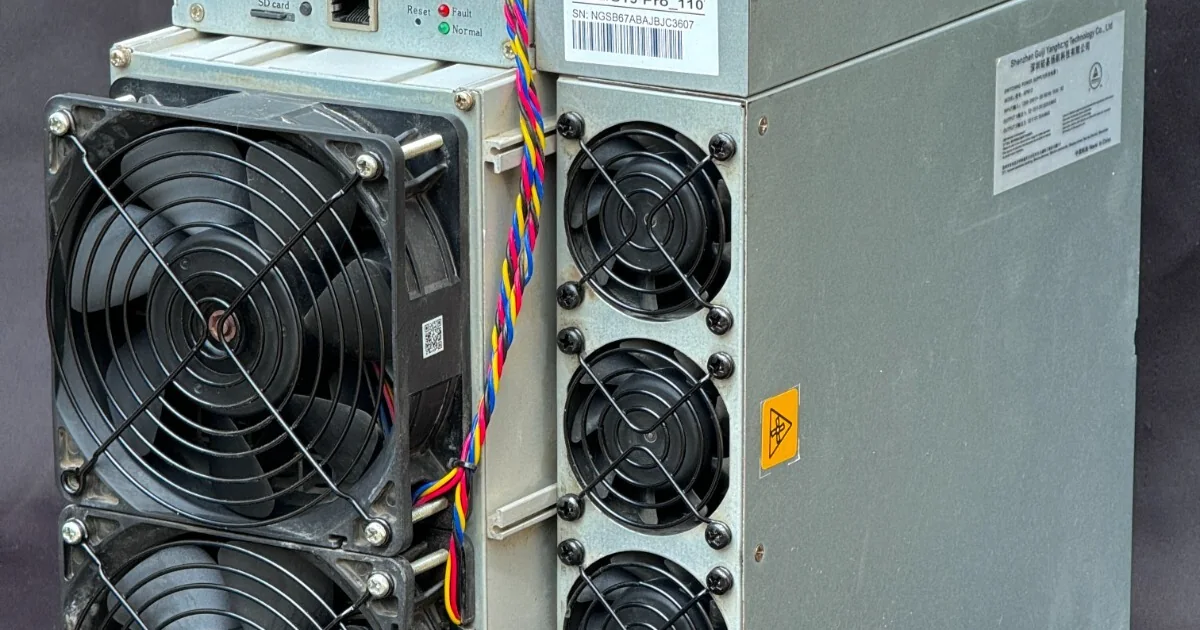
Finding clear answers about Bitcoin mining can feel overwhelming when technical terms and myths often outnumber facts. Understanding complex mathematical puzzles and how mining really supports the Bitcoin network is crucial before spending a single dollar on hardware or electricity. This guide cuts through common misconceptions, highlights what miners actually do, and shows how to weigh costs so you can make smart decisions about using ASIC hardware at home or with small operations.
Bitcoin Mining Defined and Common Misconceptions
Bitcoin mining is the computational process of verifying transactions and recording them on the blockchain. Miners solve complex mathematical puzzles to validate transactions; the first to solve it earns newly created bitcoins and transaction fees. This process serves two critical functions: it secures the network and releases new currency into circulation.
Many people confuse Bitcoin mining with physical gold mining because of the name. The comparison breaks down quickly. Gold mining extracts finite resources from the earth, while Bitcoin mining is a decentralized computational process that has no physical component.
What Bitcoin Mining Actually Does
Miners perform three essential jobs:
- Validate transactions to prevent double-spending (spending the same bitcoin twice)
- Record verified transactions into blocks on the blockchain
- Earn rewards (currently 3.125 bitcoins per block plus transaction fees, following the April 2024 halving) for completing this work
How mining works profitably requires understanding that miners compete globally. The first miner to solve the puzzle gets the reward. This competition keeps the network secure because attacking it would cost more than any attacker could gain.
Common Misconceptions About Mining
Misconception 1: Mining creates something valuable from nothing. False. Miners use significant electricity to solve puzzles that secure the network. The work is real; the value is earned through computational effort and electricity expenditure.
Misconception 2: Mining is basically “free money.” Not remotely. Miners invest in hardware, pay electricity bills, manage cooling and maintenance, and compete against thousands of other operations. Many miners operate at losses when hardware depreciates and power costs rise.
Misconception 3: Miners control Bitcoin. Incorrect. Miners process transactions, but the Bitcoin network rules are defined by the code. Miners cannot change Bitcoin’s core rules (like the 21 million coin cap) without consensus from the broader network.
Misconception 4: Anyone can mine profitably from home. This depends entirely on your electricity costs and hardware choice. What mining hardware offers determines profitability. Residential electricity in the U.S. typically costs $0.12–$0.16 per kilowatt-hour. Commercial mining operations in low-cost regions pay $0.04–$0.08. The difference determines whether you profit or lose money.
Understanding these definitions and correcting misconceptions before investing in hardware saves you from costly mistakes. Real mining success requires honest assessment of costs, not hope.
Work out your exact electricity cost per kilowatt-hour before you buy anything, then compare it against the machine’s efficiency. Break-even is hashprice divided by 24 times J/TH: at the $32.10/PH/day hashprice measured on 30 July 2026 that puts the efficient machines on our shelf between roughly 3.9¢/kWh and 9.0¢/kWh. The US residential average is 18.44¢/kWh (EIA, May 2026), which is why home mining on grid power at retail rates is so hard to make pay.
Types of Bitcoin Miners and Mining Methods
Bitcoin miners come in three main categories: individuals running solo operations, groups participating in mining pools, and cloud mining services. Your choice determines income consistency, upfront costs, and technical requirements. Understanding each type helps you pick the approach that matches your resources and goals.
Solo Mining
Solo mining means you compete alone to find blocks and earn full rewards. You keep 100% of the newly created bitcoins plus transaction fees when you solve a block. The tradeoff is severe: variance is extremely high.
Here’s the reality of solo mining:
- You might mine for weeks without solving a single block
- When you finally solve one, you earn the entire reward (currently 3.125 BTC plus fees)
- Requires industrial-grade hardware and very cheap electricity to remain viable
- Most home miners never find a block due to network difficulty
Solo mining made sense in 2009. Today, the network difficulty is so high that your odds of winning are measured in years, not days. Unless you operate a commercial facility with thousands of machines, solo mining is unlikely to produce results.
Pool Mining
Pool mining combines your computational power with thousands of other miners. When the pool finds a block, rewards are split proportionally to the computing power each miner contributed.
Solo mining and pooled mining show a clear difference: pools provide steady, predictable income but at reduced individual rewards. A pool might find blocks every few hours. Your share depends on your hardware’s hashpower relative to the entire pool.
Pool mining advantages:
- Consistent, predictable income (weekly or daily payouts)
- Lower variance—you earn small amounts regularly instead of waiting months
- Works with modest hardware; pools accept miners from home operations
- Pool operators handle block validation and reward distribution
Cloud Mining
Cloud mining lets you rent hash power from companies that operate large facilities. You pay a fee, they handle hardware, cooling, electricity, and maintenance. Rewards flow to your wallet weekly or monthly.
Cloud mining sounds appealing but carries real risks:
- Fees are deducted daily from earnings and are rarely quoted as a single percentage you can compare — which is the first thing to be suspicious of
- Difficulty increases over time; your daily earnings shrink as the network grows
- No transparency into actual hardware or operations at many providers
- Contract terms often lock you in; you cannot exit if the deal becomes unprofitable
- Some cloud mining companies are outright scams
Most experienced miners avoid cloud mining entirely. The economics rarely work in your favor compared to running your own hardware through a pool.
Which Method Works for You?
ASIC miners enable profitable operations when paired with pool mining and competitive electricity rates. Solo mining requires resources most home operators do not possess. Cloud mining typically underperforms due to excessive fees.
Your best path as a beginner: Start with pool mining using quality ASIC hardware, reliable electricity under $0.10/kWh, and a reputable mining pool like Stratum V2 compatible pools or industry-standard operators.
Join multiple pools simultaneously using separate worker accounts; if one pool experiences downtime, your hardware automatically switches to backup pools, maximizing uptime and consistent earnings.
Here’s a comparison of the main Bitcoin mining methods to help clarify their differences:
How ASIC Mining Hardware Works and Requirements
ASIC miners are specialized computer chips built exclusively for Bitcoin mining. Unlike CPUs or GPUs (which handle general computing), ASICs perform one task repeatedly: computing cryptographic hashes as fast as possible. This laser focus on a single job makes ASICs vastly more efficient than general-purpose hardware.
How ASIC Miners Actually Work
Here’s the basic process: Your mining software receives a block template from a mining pool or node. The software constructs block headers containing transaction data and a nonce (a number that changes with each attempt). The ASIC then hashes that header billions of times per second, modifying the nonce slightly with each iteration.
When ASIC miners compute hashes, they’re searching for a hash result below the network difficulty target. The first miner to find a valid hash submits it as a solved block. The process repeats endlessly—your hardware generates hashes, rejects invalid ones, generates more hashes, until a winner emerges.
The speed matters enormously. Modern ASIC miners generate hundreds of trillions of hashes per second — a used S19 does 95 trillion, and a new S21 Pro 245 trillion. A laptop CPU manages some tens of millions. That is a gap of roughly ten million to one, not a thousand to one, and it is why general-purpose hardware has not been able to mine Bitcoin since 2013.
Power and Cooling Requirements
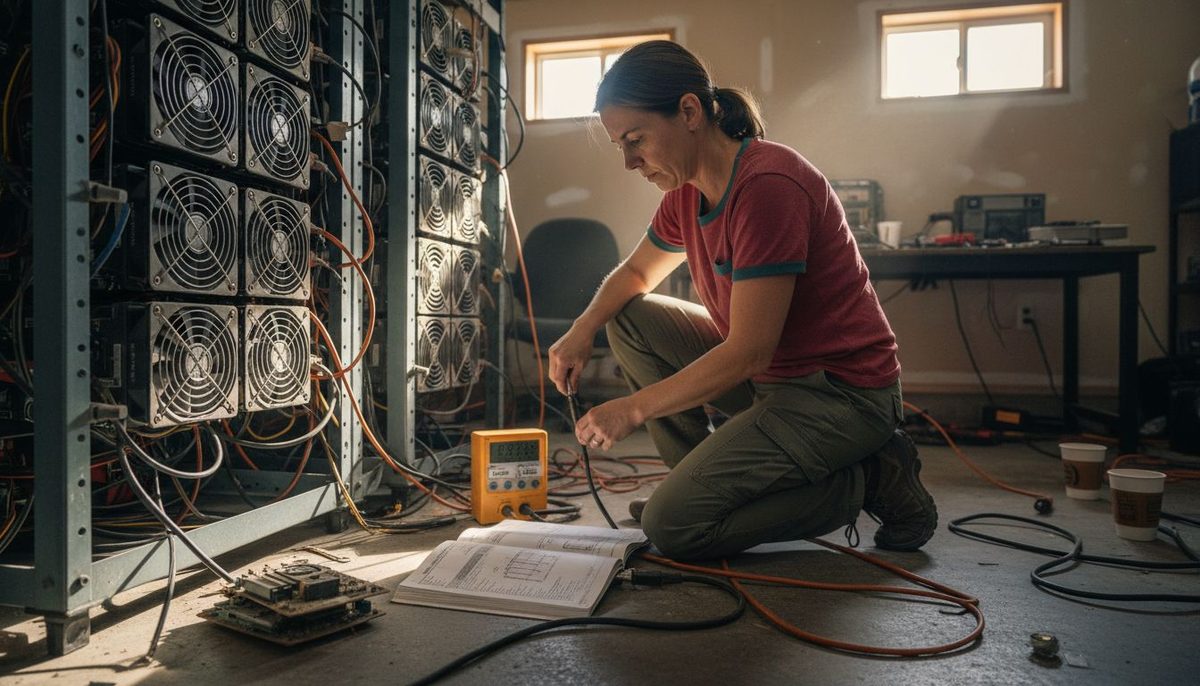
Power consumption is not negotiable. ASIC miners require significant power and specialized cooling to operate reliably. Modern models consume 1,000-3,500 watts continuously.
Critical requirements for safe operation:
- Dedicated electrical circuits rated for consistent, sustained draw
- 240-volt service (in the U.S.) for efficiency; 120-volt operation wastes electricity
- Adequate cooling: ambient temperatures above 80°F degrade performance and reduce lifespan
- Proper ventilation to exhaust heat (typically 3,000-6,000 BTU/hour per miner)
- Uninterruptible power supply (UPS) to protect against brownouts and surges
- Ambient humidity 30-60%; higher humidity risks corrosion
Real-World Operating Considerations
Power efficiency varies dramatically between models. Older ASIC models (2018-2020) consume 1,500-2,000 watts per terahash of computing power. Newer models (2023-2024) achieve 20-30 watts per terahash. That difference determines profitability.
Your location matters more than hardware specs:
- Electricity cost: the only threshold that means anything is the machine’s own. Break-even $/kWh is hashprice ÷ (24 × J/TH), which today puts a new S21 Pro at about 8.8¢/kWh and a used S19 at about 3.9¢. The US residential average is 18.44¢ (EIA, May 2026), so a home rate does not clear either of them
- Ambient temperature: Cool locations reduce cooling costs and extend hardware lifespan
- Network noise: Many residential areas restrict or ban mining due to noise (85-90 decibels continuously)
Hardware lifespan typically runs 3-5 years under normal conditions. Many units fail sooner due to dust accumulation, inadequate cooling, or power surges. Maintenance involves cleaning intake filters monthly and monitoring thermal conditions continuously.
The Bottom Line on Requirements
Successful ASIC mining demands more than just buying hardware. You need reliable, cheap electricity; proper cooling infrastructure; maintenance discipline; and honest assessment of depreciation costs. Run the numbers before purchasing.
Test your cooling setup with a dummy load (space heater) before deploying an ASIC miner; if your room cannot handle the heat, your miner will throttle performance or fail prematurely.
Costs, Electricity, and Real-World Profitability
Electricity is not a secondary expense in mining—it is the primary expense. Bitcoin mining consumes substantial electricity due to the computational work required to secure the blockchain. For most miners, power costs represent 60-80% of total operating expenses. Everything else matters less if your electricity math doesn’t work.
Breaking Down Real Mining Costs
Starting a mining operation requires both upfront and ongoing expenses:
- Hardware: on our own shelf, $159.99 for a tested S19 up to $4,200 for a new S21 Pro 245T. The spread is efficiency — the cheap machine costs more per terahash to run, every day, forever
- Electricity: derive it rather than guess. An S21 Pro pulls 88.2 kWh a day, so 32,193 kWh a year — $1,932 at 6¢/kWh, $5,937 at the 18.44¢ residential average
- Cooling infrastructure: Fans, ventilation, or air conditioning ($500-$3,000+)
- Electrical upgrades: Circuits, wiring, breakers ($1,000-$5,000 for home operations)
- Maintenance: Filter replacements, thermal paste, occasional repairs ($200-$500/year)
- Depreciation: steeper than any percentage suggests, and this shelf is the evidence. The S19 was flagship hardware when it shipped; it is $159.99 here now, beside a current S21 Pro at $4,200
Most home miners underestimate total costs. They focus on hardware price and ignore electrical infrastructure, cooling, and depreciation. That mistake destroys profitability.
Why Electricity Cost Is Everything
Consider two operators running the same S21 Pro 245T. Both earn the same $7.77 a day gross at today’s hashprice, and both burn 88.2 kWh a day. Operator A pays 6¢/kWh, so the power costs $5.29 and she keeps $2.48 a day. Operator B pays 14¢, so the power costs $12.35 and he loses $4.58 a day. Identical hardware, identical revenue, and one of them is running a business while the other is buying bitcoin at a premium.
Energy costs determine mining profitability more than any other factor. Regional electricity pricing creates massive profitability gaps. There is no single rate at which mining stops working, which is why we will not print one. There is a rate per machine: divide today’s hashprice by 24 times the machine’s J/TH and you have the exact figure at which that unit earns nothing. Everything this store sells lands between 3.9¢ and 9.0¢/kWh, and every one of those is below the US residential average.
Real-World Profitability Assessment
Take the S21 Pro 245T we sell at $4,200. It draws 3,675 W, so it burns 88.2 kWh a day and 2,646 kWh in a 30-day month. At the hashprice measured on 10 August 2026 it earns $7.77 a day, about $233 a month gross.
- At $0.06/kWh: $159 of electricity a month — about $74 a month net
- At $0.10/kWh: $265 — roughly $32 a month underwater
- At $0.14/kWh: $370 — $137 a month underwater
- At $0.1844/kWh, the US residential average: $488 — $255 a month underwater
The crossover is 8.8¢/kWh, and it is not a matter of opinion: it is hashprice divided by 24 times the machine’s 15.0 J/TH.
These figures change constantly as Bitcoin price, network difficulty, and hardware efficiency shift. What works today may not work next month.
To quickly assess real-world ASIC miner profitability, here’s a summary:
| Electricity Rate | Monthly Power Cost | Profit Potential |
|---|---|---|
| $0.06/kWh | $159 | About $74/month net |
| $0.10/kWh | $265 | Margins are slim |
| $0.14/kWh | $370 | Usually unprofitable |
Hardware Depreciation and Lifespan
ASIC miners typically operate 3-5 years before failure. New models release annually, rendering older hardware less competitive. Depreciation runs approximately 25-35% in year one alone.
If you buy a $4,000 miner expecting 4-year profitability, depreciation alone costs you $1,000-$1,400 annually. Factor that into your calculations.
Legal, Tax, and Safety Risks for Home Miners
Mining Bitcoin generates income. That income has tax consequences. Many home miners ignore this reality until the IRS sends a notice. Understanding your obligations prevents costly mistakes and legal exposure.
Tax Obligations You Cannot Ignore
Bitcoin mining presents complex tax challenges that extend beyond simple profit-and-loss calculations. Mining income is taxable as ordinary income in the United States. When you mine and receive Bitcoin, that income is valued at fair market price on the day received.
Here’s what triggers tax liability:
- Mining rewards received are taxable income at receipt (not when you sell)
- Selling mined Bitcoin creates capital gains tax (short-term or long-term depending on holding period)
- Operational expenses (electricity, hardware, repairs) are deductible as business expenses
- You must report all mining income—the pseudonymous nature of crypto does not hide it
Example, using Bitcoin at $63,378 — the price on 28 July 2026, and the number you should replace with the price on the day you actually receive the reward. You mine 1 BTC. That $63,378 is ordinary income at the moment of receipt, whether or not you ever sell it. Sell a month later at $66,000 and you owe short-term capital gains on the $2,622 difference. Hold it two years and sell at $80,000 instead, and the $16,622 gain is taxed at long-term rates. Receipt and sale are two separate taxable events, and treating them as one is the most common mistake miners make on their first return.
Regulatory and Compliance Risks
Bitcoin mining activities require compliance with evolving regulations as government agencies clarify rules. The regulatory landscape changes constantly. What was unclear last year may be explicitly regulated this year.
Critical compliance areas:
- Operating without proper business licensing or permits
- Failing to report income on tax returns (IRS detection is increasing)
- Operating in residential zones where mining is prohibited by local ordinance
- Electrical code violations creating fire or safety hazards
- Not maintaining records of mining activity, rewards, and expenses
Physical Safety Risks
ASIC miners create real hazards in home environments. Many miners skip safety measures to save money—a false economy.
Common safety issues:
- Electrical fires from improper circuits or overloaded breakers
- Heat damage to home structures and insulation
- Carbon monoxide buildup from inadequate ventilation
- Noise complaints leading to citations or forced shutdown
- Tripping circuit breakers repeatedly, indicating overload
- Inadequate cooling causing equipment failures or thermal events
Run 240-volt circuits properly. Install dedicated breakers. Ensure adequate ventilation. Monitor temperatures continuously. These steps cost money upfront but prevent catastrophic losses.
Zoning and Neighborhood Issues
Many residential areas restrict mining through zoning ordinances, HOA rules, or noise ordinances. Operating illegally risks fines, forced equipment removal, or legal action from neighbors.
Before starting:
- Check local zoning laws and permitted uses
- Review your HOA restrictions if applicable
- Verify noise limits in your jurisdiction (many cap at 50-70 decibels)
- Notify your utility company (some have mining restrictions)
- Confirm electrical capacity with a licensed electrician
Mining is one division dressed up as an industry: hashprice ÷ (24 × J/TH) is the electricity price at which your machine stops making money. Ours sit between about 3.9¢ and 9.0¢/kWh against a US residential average of 18.44¢. The full working is in the ASIC miner buying guide, and the machines are on the used ASIC miner shelf.
Frequently Asked Questions
What is Bitcoin mining?
Bitcoin mining is the process of verifying and recording transactions on the blockchain by solving complex mathematical puzzles. Miners earn newly created bitcoins and transaction fees for their work.
How do miners make money from Bitcoin mining?
Miners earn rewards by validating transactions and adding them to blocks on the blockchain. The current reward is 3.125 bitcoins per block plus transaction fees. It halved from 6.25 in April 2024 and is due to halve again around 2028, so any calculation still using 6.25 overstates mining revenue by a factor of two. However, profitability depends largely on electricity costs and the efficiency of their hardware.
What are the different types of Bitcoin mining methods?
The main types of Bitcoin mining include solo mining, pool mining, and cloud mining. Solo mining involves working independently to find blocks, pool mining combines resources with other miners for steady income, and cloud mining takes advantage of renting processing power from remote facilities.
What factors affect the profitability of Bitcoin mining?
Profitability in Bitcoin mining is heavily influenced by electricity costs, mining hardware efficiency, network difficulty, and the current price of Bitcoin. Miners need to calculate these elements carefully to determine their potential earnings.
More on how mining works
- Where New Bitcoins Come From: The Block Subsidy, the Halving and the 21 Million Cap
- Bitcoin and Blockchain: A Beginner’s Guide
- What Is Bitcoin? And What Mining Actually Does
- ASIC Mining: Why It Matters for Home Miners
The machines these numbers get run against
The machines these numbers actually get run against:
- Bitmain Antminer S19K Pro 115T – High-Efficiency SHA-256 Miner
- Bitmain Antminer S21+ 235T | High-Performance SHA-256 Miner
- Bitmain Antminer S21+ 216T – Efficient SHA-256 Bitcoin Miner
More in Bitcoin miner, or the full ASIC miner inventory. The arithmetic behind all of this — break-even electricity price from J/TH — is set out in our ASIC miner buying guide.