
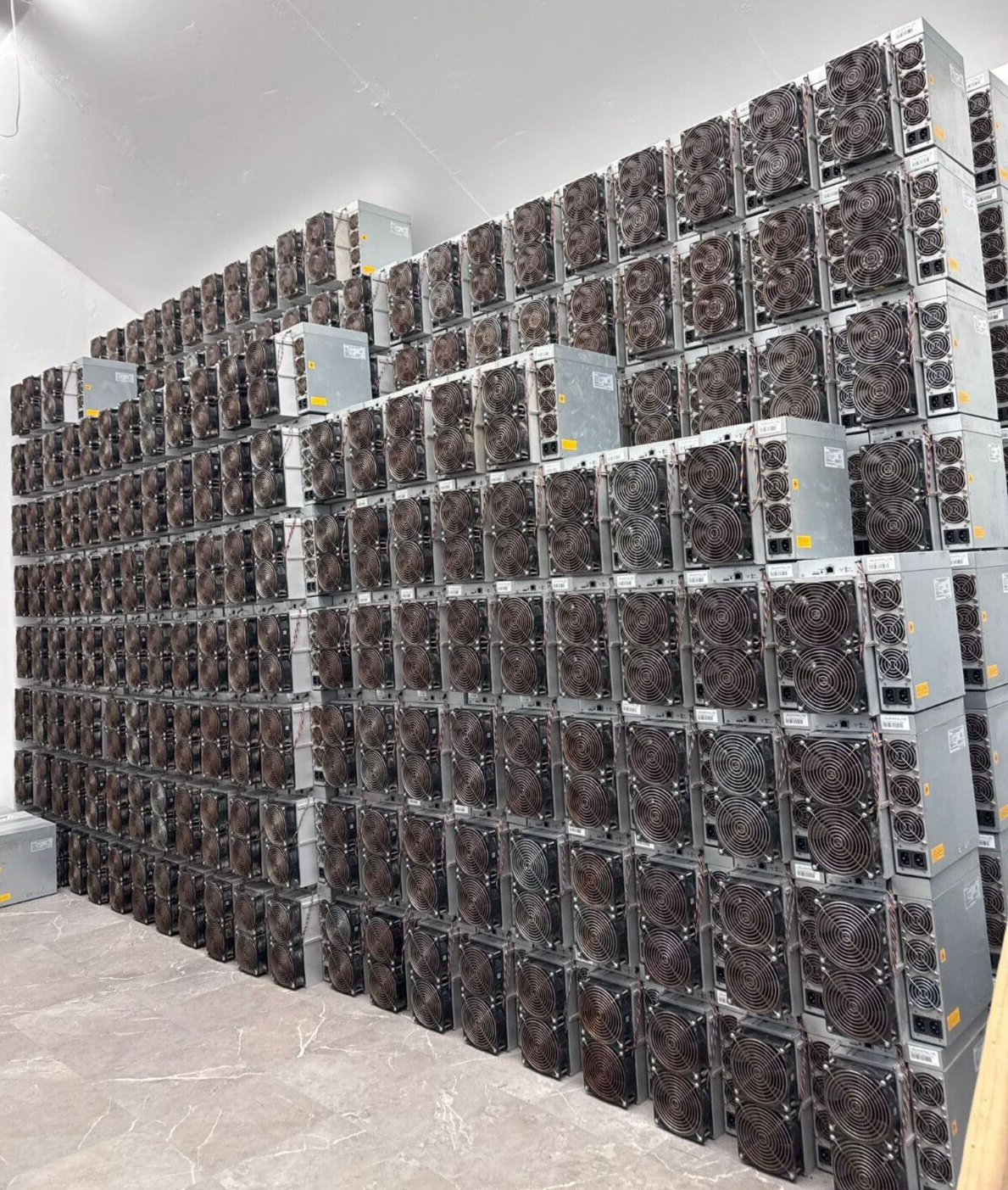
The advantage of buying used ASIC miners is real, it is much larger than the “about half price” figure most guides quote, and it is one number rather than seven: capital cost per terahash. On our own shelf today a used Antminer S19 in a pallet lot works out under $2 per TH/s. A new S21 Pro is around $17 per TH/s. That is roughly a ten-fold difference in what you pay for the same unit of hashrate, and every other “advantage of buying used” on the usual list — faster payback, lower depreciation exposure, cheaper pilot sites — is a consequence of that one number, not a separate benefit.
That per-terahash gap is at its widest in lot quantities, which is where the second question starts to matter more than the price: what condition the batch is actually in. Both are covered on bulk used ASIC miners.
It is also completely cancelled by a second number: the electricity price above which the machine stops earning. A used S19 stops earning at about 3.9¢/kWh. Buy fifty of them at any price at all and plug them in at 6¢, and you have bought fifty things that lose money every day they run. This page works both numbers with our own stock and today’s network figures, because the version of this argument that only shows you the first number is a sales pitch.
We buy, repair, host and resell this hardware. Some of what follows argues against our own used listings.
The numbers this page uses, and when they were true
- Hashprice: ~$31.8 per PH/s per day (measured 28 July 2026)
- Network difficulty: 126.23 T; network hashrate ~867 EH/s
- BTC: ~$63,378; transaction fees ~0.7% of the block reward
- US average residential electricity: 18.44¢/kWh (EIA, May 2026)
All of these move daily. Re-run the arithmetic on the day you buy — the method below survives, the answers do not.
Capital per terahash: the advantage, sized properly
Divide what a machine costs by the hashrate it produces. Do it for what is actually on our floor rather than for list prices, and the gap is not subtle:
| Machine | Condition | Roughly, per TH/s |
|---|---|---|
| Antminer S19 95TH, hundred-unit lot | used | about $1† |
| Antminer S19 95TH, fifty-unit lot | used | under $2† |
| Antminer S19k Pro 115TH, single unit | used | about $3 |
| Canaan Avalon Q 90T | new | about $22 |
| Antminer S21 Pro 245T | new | about $17 |
† The two lot rows are what those lots were listed at up to 11 August 2026; neither carries a price today. Every lot on this shelf is now quoted rather than sold through the cart, so the per-machine figure comes back on a quote. The single-unit rows are live prices.
Ten to twenty times, not two times. That is the honest size of the thing, and it is worth stating plainly because understating it makes the used case sound like a small saving when it is the largest single lever in the purchase.
Two caveats that the table cannot show you. First, our per-unit price does not fall smoothly as lot size rises. In the price book those lots carried up to 11 August 2026, the forty-unit S19 lot worked out dearer per machine than the ten-unit lot and the three-hundred dearer than the fifty; a ten-pack of S19k Pros cost more per machine than buying them singly. That is what happens when stock is bought as job lots at different times rather than priced off a schedule. Lots are quoted rather than listed now, which removes the ladder altogether — so divide whatever you are quoted by the machine count yourself and compare, every time. Do not assume bigger is cheaper. The same warning applies to buying miners by the pallet anywhere.
Second, a boosted hashrate in a listing title is not a specification. An S19 95TH advertised as “boost to 105TH” or “VNish 130TH tune” is running above stock clocks and drawing more power to do it. If you compute capital per terahash off the boosted figure you will flatter the machine twice — once on capital, once on efficiency. Use the stock rating, and ask for a measured wall draw at the tune the machine will actually run.
The number that cancels it: break-even electricity price
Efficiency, in joules per terahash, sets the electricity price at which a machine’s revenue exactly equals its power bill. The formula is the one the ASIC miner buying guide derives, and it is the only piece of arithmetic on this page you need to memorise:
break-even $/kWh = hashprice ÷ (24 × J/TH)
Hashrate cancels out of it entirely. A big inefficient machine and a small inefficient machine die at the same power price. At $31.8/PH/day:
| Machine | Stock power | J/TH | Break-even |
|---|---|---|---|
| Antminer S19 95TH (used) | 3,250 W | 34.2 | 3.9¢/kWh |
| Antminer S19 Pro 110TH (used) | 3,250 W | 29.5 | 4.5¢/kWh |
| Antminer S19k Pro 115TH (used) | 2,645 W | 23.0 | 5.8¢/kWh |
| Antminer S19 XP 141TH (used) | 3,010 W | 21.5 | 6.2¢/kWh |
| Canaan Avalon Q 90T (new) | 1,674 W | 18.6 | 7.1¢/kWh |
| Antminer S21 Pro 245T (new) | 3,675 W | 15.0 | 8.8¢/kWh |
Not one of these survives the US residential average of 18.44¢/kWh. At that rate a used S19 loses on the order of $340 a month and a new S21 Pro loses about $230 a month — the new machine loses less, but both lose. If your power is metered at a normal domestic tariff, the answer to “should I buy used or new” is neither, and no discount on the hardware changes it. What changes it is a different tariff, a hosting contract, or heat you would otherwise have paid to produce.
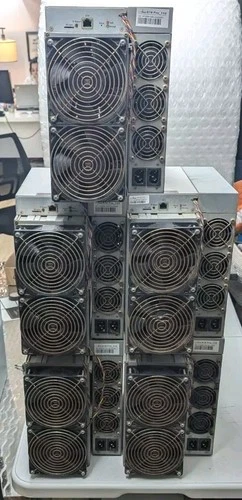
Where the used advantage actually lands
Put the two numbers together and the used case stops being a slogan. Payback here is on hardware capital only, at 100% uptime, ignoring freight, racking and repairs — so treat it as a ceiling, not a forecast:
| Machine | Margin at 3¢/kWh | Payback at 3¢ | Margin at 5¢/kWh | Payback at 5¢ |
|---|---|---|---|---|
| Used S19 95TH (lot price) | ~$20/month | ~7 months | ~−$27/month | never |
| Used S19k Pro 115TH | ~$53/month | ~7 months | ~$15/month | ~26 months |
| New S21 Pro 245T | ~$158/month | ~27 months | ~$107/month | ~39 months |
Read the first row and the last row together, because that is the whole argument. At 3¢/kWh the used S19 returns its purchase price nearly four times faster than the new machine. Move the same two machines to 5¢ and the used S19 is worthless while the new one still pays back inside four years. The used advantage is not a discount you keep. It is a discount you keep only while your power is cheap.
Which is why the middle row matters most to actual buyers. A used S19k Pro sits at about $3 per terahash and survives to 5.8¢ — it captures most of the capital advantage without the cliff edge sitting immediately underneath your tariff. If your power is somewhere between 4 and 7¢, that band of used hardware, not the cheapest thing on the pallet, is what you want.
What the saving buys back out again
Four costs sit on used hardware that do not sit on new, and none of them appears in a per-terahash comparison.
Failures arrive immediately rather than eventually. A used machine has already spent its warranty period generating heat. The power supply is the usual first casualty — it runs at full load and high temperature for the machine’s whole life — followed by fans, then a hashboard. Budget a spare PSU per handful of machines from the outset rather than after the first failure. What each part costs and what it fits is set out in the Antminer parts compatibility guide.
There is no manufacturer RMA channel. Whatever a used seller offers — and ours is stated on each listing — it is a seller’s warranty, not Bitmain’s. That is a real difference in what happens in month fourteen, and it is the strongest single argument for new hardware if you have no appetite for maintaining anything.
Mixed bins cost labour. Fifty machines bought as one lot are rarely one configuration. Different firmware, different board revisions, occasionally different PSU models. That is fine at ten machines and a real overhead at three hundred, because every spare you stock has to cover every variant you own.
The efficiency gap is a recurring bill. A 34.2 J/TH machine and a 15.0 J/TH machine producing the same hashrate differ by roughly 2.3× on electricity, every month, forever. Cheap capital does not offset expensive power indefinitely — that is exactly what the break-even table above is measuring. Our page on ASIC depreciation and how it is treated for tax covers the other half of that ledger.
When used is the right answer, and when it is not
Buy used when: your power is genuinely below about 5¢/kWh; you are testing a site, a tariff or a landlord before committing; you want maximum hashrate per dollar of capital and can tolerate maintaining it; or you are buying a pallet as a parts pool as much as a fleet, which is a legitimate strategy and one we sell into.
Buy new when: your power is between roughly 6 and 9¢/kWh, where only current-generation efficiency still clears break-even; you need a manufacturer warranty; you are hosting, where the host’s all-in rate is usually 5.5–8.5¢ and older hardware simply does not clear it; or the machine has to live in a house, where the Avalon Q’s 1,674 W and low noise solve a problem no used S19 can.
Buy nothing when your only available power is a domestic tariff near the national average. That is most people asking this question, and telling them otherwise is how the rest of the internet sells miners.
Before you send money for used hardware
The capital arithmetic assumes the machine works and is what the listing says. Verifying that is a separate job, covered properly in how to buy a used ASIC miner without getting burned and in our testing measurements guide. The short version: ask for per-board hashrate and chip count from the miner’s own interface, ask for measured wall draw at the tune it will ship on, ask what the seller’s warranty actually covers and for how long, and treat a grade letter as a seller’s opinion rather than a standard — because no industry body defines those grades, including when we use them. What refurbishment does and does not repair is covered in why we refurbish ASIC miners; it restores condition, not silicon efficiency.
Frequently Asked Questions
What is the main advantage of buying used ASIC miners?
Capital cost per terahash. On our own stock a used Antminer S19 in a lot worked out under $2 per TH/s in the price book those lots carried to 11 August 2026, against roughly $17 for a new S21 Pro — about a ten-fold difference for the same unit of hashrate. Every other commonly listed advantage, including faster payback and reduced depreciation exposure, follows from that one figure rather than being separate from it.
Do used ASIC miners really pay back faster than new ones?
Only where electricity is cheap. At 3¢/kWh a used S19 bought at lot pricing returns its purchase price in roughly seven months against about twenty-seven months for a new S21 Pro. At 5¢/kWh the used machine never pays back at all because it is losing money every day it runs, while the new one still clears in a little over three years. Payback is a function of your power price, not of the hardware’s age.
At what electricity price does a used Antminer S19 stop being worth running?
About 3.9¢/kWh at a hashprice of $31.8 per PH/s per day, measured 28 July 2026. The calculation is hashprice divided by 24 times the machine’s efficiency in joules per terahash, which for a stock 95TH S19 is 34.2. Above that rate the machine burns more electricity than it earns regardless of what you paid for it, and the figure moves every time hashprice does.
Is a used miner still worth buying at normal household electricity rates?
No. The US residential average was 18.44 cents per kilowatt-hour in May 2026, and no ASIC currently sold — used or new — breaks even at that rate. A used S19 loses roughly $340 a month there and a new S21 Pro roughly $230. Home mining needs a below-average tariff, a hosting arrangement, or genuine value from the heat before the hardware choice matters at all.
Which used miner is the best value if my power is not extremely cheap?
A used S19k Pro rather than the cheapest S19 on the pallet. It sits at roughly $3 per terahash and breaks even near 5.8¢/kWh, so it keeps most of the capital advantage without the shutdown price sitting immediately below a typical commercial tariff. Buying the cheapest machine available is the common mistake; buying the cheapest machine that clears your actual power rate is the decision.
What extra costs come with used mining hardware?
Four that a price-per-terahash comparison hides: earlier failures, with the power supply usually first; no manufacturer RMA, only whatever the seller’s own warranty covers; the labour of stocking spares for mixed board and firmware revisions across a lot; and a permanently higher electricity bill, since a 34.2 J/TH machine burns roughly 2.3 times the power of a 15.0 J/TH one for the same hashrate.
Does buying a bigger lot always lower the price per machine?
Not on our shelf, and not reliably anywhere. In the price book our lots carried up to 11 August 2026 the forty-unit S19 lot worked out dearer per machine than the ten-unit lot, and a ten-pack of S19k Pros cost more per machine than buying them singly, because stock is acquired as job lots at different times rather than priced from a schedule. Our lots are quoted rather than listed now, so divide whatever you are quoted by the machine count and compare that figure directly every time, rather than assuming the larger quantity is the better deal.
Should I use the boosted hashrate in a used listing title for my calculations?
No. A figure like “boost to 105TH” or “VNish 130TH tune” describes the machine running above stock clocks and drawing more power to do it. Using it flatters both capital per terahash and efficiency at once. Calculate from the stock rating and ask the seller for a measured wall draw at the firmware and tune the unit will actually ship running.
Used and refurbished stock on the floor now
If you are shopping this way, here is what is on the floor right now:
- Lot of 5 Refurbished Bitmain Antminer S19 110TH/s Miners – Boosted, Braiins OS
- Refurbished Bitmain Antminer S19 XP 141TH/s Bitcoin Miner – BraiinsOS Capable
- Used Antminer KS5 Pro 21TH/s Kaspa Miner – Tested KHeavyHash ASIC
More in Used ASIC miners, or the full ASIC miner inventory. Whether a used machine still earns comes down to your power price; the buying guide has the formula.