
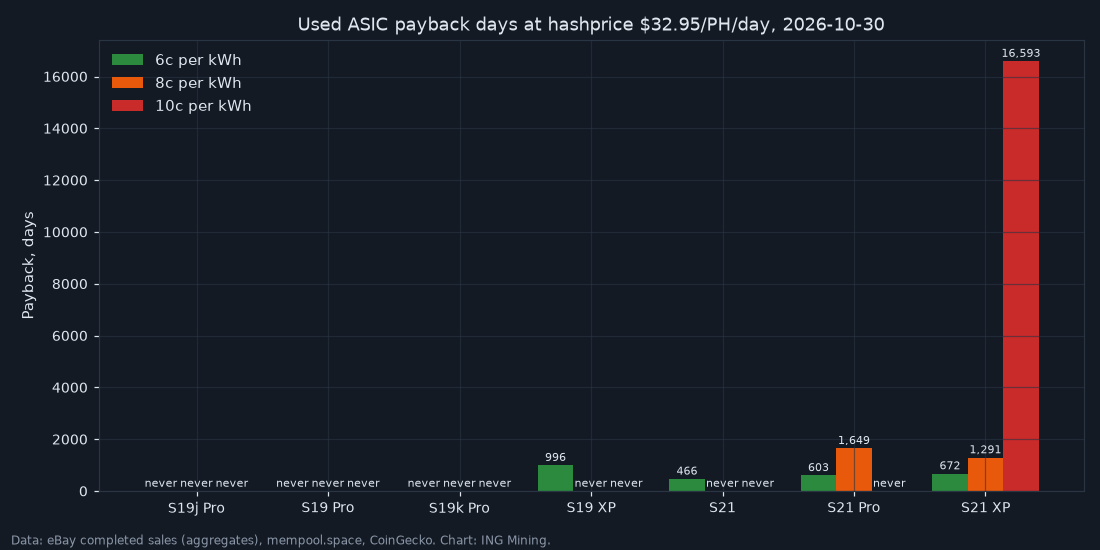
In short, the used ASIC payback index shows how long a second-hand miner takes to earn back its price. For this, it uses 189 completed eBay sales from the last 90 days and live hashprice of $0.0329 per terahash per day. So at 8 cents power, the S21 XP pays back fastest, in about 1,291 days (3.5 years). However, at the same power price, the S19j Pro, the S19 Pro, the S19k Pro, the S19 XP and the S21 never pay back.
What a used ASIC sold for
First, the prices. These are quartiles per model for sales from August 1 to October 30, 2026. Sold $/TH divides each price by the terahash figure in the listing. However, we only count units inside the rated band, so a mislabelled machine does not skew it.
| Model | Sales (n) | Q1 | Median | Q3 | Median sold $/TH (n) |
|---|---|---|---|---|---|
| S19j Pro | 14 | $185 | $325 | $398 | $3.00 (11) |
| S19 Pro | 6 | $195 | $200 | $250 | $1.82 (6) |
| S19k Pro | 20 | $300 | $350 | $423 | $2.92 (20) |
| S19 XP | 69 | $255 | $310 | $400 | $2.06 (61) |
| S21 | 26 | $575 | $722 | $985 | $3.81 (21) |
| S21 Pro | 11 | $1,570 | $1,600 | $1,800 | $6.84 (11) |
| S21 XP | 20 | $2,178 | $2,450 | $2,800 | $8.88 (18) |
| L7 | 23 | $375 | $395 | $449 | n/a |
Used ASIC payback days at today’s hashprice
In other words, payback is the median sold price divided by daily profit after power. Right now bitcoin is $77,841, the network runs at 1068 EH/s, and hashprice is $32.95 per petahash per day. Next, we scale each machine’s rated power draw to the terahash of the typical unit sold. However, pool fees and downtime are not included, so real payback is a little longer.
| Model | Typical unit | 6c/kWh | 8c/kWh | 10c/kWh |
|---|---|---|---|---|
| S19j Pro | 100 TH/s, 2,950 W | never | never | never |
| S19 Pro | 110 TH/s, 3,250 W | never | never | never |
| S19k Pro | 120 TH/s, 2,760 W | never | never | never |
| S19 XP | 141 TH/s, 3,010 W | 996 | never | never |
| S21 | 200 TH/s, 3,500 W | 466 | never | never |
| S21 Pro | 234 TH/s, 3,510 W | 603 | 1,649 | never |
| S21 XP | 270 TH/s, 3,645 W | 672 | 1,291 | 16,593 |
So “never” means the machine earns less than its power costs at that rate. In that case, a lower price does not fix it, because the loss repeats every day.
Cost to mine one bitcoin with a used ASIC
Power alone costs a set amount per bitcoin, whatever the machine cost. Bitcoin is $77,841 today, so compare the power columns with that price. Then add the machine price from the last column.
| Model | Days to mine 1 BTC | Power cost at 6c | Power cost at 8c | Power cost at 10c | Median sold price |
|---|---|---|---|---|---|
| S19j Pro | 23,626 | $100,364 | $133,819 | $167,274 | $325 |
| S19 Pro | 21,478 | $100,519 | $134,025 | $167,531 | $200 |
| S19k Pro | 19,689 | $78,250 | $104,333 | $130,417 | $350 |
| S19 XP | 16,756 | $72,628 | $96,837 | $121,047 | $310 |
| S21 | 11,813 | $59,538 | $79,384 | $99,230 | $722 |
| S21 Pro | 10,097 | $51,033 | $68,044 | $85,054 | $1,600 |
| S21 XP | 8,750 | $45,929 | $61,239 | $76,549 | $2,450 |
At 8 cents, the S21 XP has the lowest power bill per bitcoin, at $61,239. However, that is power only, so the machine price comes on top.
Does hashprice move used ASIC prices?
We tested one model at a time. For each week we took the median sold $/TH and the average hashprice from CoinGecko and mempool.space. Then we measured how closely the two move together. The range is a 95% bootstrap interval, which resamples the weeks 4,000 times. Only S19 XP had enough weeks with 3 or more sales, so we did not test the other models.
| Model | Weeks | Correlation, price levels | Correlation, week-on-week change |
|---|---|---|---|
| S19 XP | 17 | 0.36 (-0.07 to 0.82) | -0.03 (-0.66 to 0.83) |
For S19 XP, the interval includes zero, so we cannot say the two moved together.
The week-on-week column matters more, because two series that both trend will correlate by accident. No model stays clearly positive there, so the level link may be mostly shared trend.
Limits of this used ASIC payback test
This is a correlation, not a cause. We have about 12 months of dense data, so each model has only a handful of weekly points. Also, the bootstrap treats weeks as independent, which they are not, so the true uncertainty is wider than shown. In addition, condition, hardware revision and seller type drift from week to week. So treat this as “moved together”, not as a forecast.
How we built the used ASIC payback index
This index is based on 189 completed eBay sales (item price, excluding shipping), August 1 to October 30, 2026. First, we removed parts, repair, lot, bundle and accessory listings, hydro and plus variants, non-US-dollar sales, sales under $150, and outliers beyond 1.5 times the interquartile range. Also, eBay is one channel, so private or over-the-counter deals are not included. In addition, Best Offer sales may show the listed price. Finally, we are not affiliated with eBay, and this is not an official market value.
For privacy, we publish only totals per model: count, quartiles and medians. Seller names, listing links and individual listings stay out. Specs are the manufacturer ratings, because they come from the same table behind our bitcoin mining profitability today page. Network data comes from mempool.space.
Download the published cells as CSV.
Our take on used ASIC payback
Our read: first, run your own power rate, because it decides everything above. Second, a low sticker price does not rescue a machine that loses money on power. For the model-by-model price history, see the Used Miner Price Index. To test your own rate, use our bitcoin mining profit calculator. If you want to buy, browse our used ASIC miners, or sell us yours.
-Nick
ING Mining
This is general information, not financial advice. Crypto is volatile, and you can lose money. Please do your own research.