Call the Close is a free daily bitcoin game. Each day you call one thing: will bitcoin finish tomorrow higher or lower than it started? Every two weeks you also call the next mining difficulty adjustment, up or down. Also, we check your calls automatically, and your streak lives in your own browser.
To be clear, there is no money in it. You cannot win a prize, and you cannot lose a cent. Instead, it is a game about reading the market, built by a company that sells mining machines.
How to play Call the Close
First, pick Higher or Lower for tomorrow. Calls are open all day and lock at 00:00 UTC, when the new day starts. Because the whole measured day is still in the future, nobody gets a head start. Then come back the next day, and the result appears on its own.
Likewise, the difficulty game works the same way. Pick Harder or Easier for the next retarget. It locks with about two days left. We show the current estimate from mempool.space, although estimates can flip before the block arrives.
How Call the Close scores your calls
In short, the reference is the bitcoin price at 00:00 UTC, and the result is the price at 00:00 UTC the next day. Both come from mempool.space, with CoinGecko as a backup. In other words, if the two prices are identical, the round is a push and does not count. Finally, difficulty rounds compare the first block of the new period with the block before it.
Your streak counts correct calls in a row. A wrong call resets it to zero. Skipping a day does not break it. However, we never invent a result: if the price data is missing, the round stays pending until it is not.
Call the Close streaks, share card and top 10
Also, your record is saved in your browser, so clearing site data resets it. You can also make a share card that says, for example, “I called 6 in a row”. It is made on your device and never uploaded.
Besides that, the top 10 is optional. If you add a nickname, we store that nickname and your calls, nothing else. Please do not use your real name. We keep no emails, no accounts and no tracking in the game. In addition, each IP address can only send a limited number of calls per hour.
What a miner learns from the game
Because price and difficulty are the two numbers that decide a miner’s margin. So the game is practice for the real thing. Our ING Mining scorecard grades our own forecasts in public, misses included. So you can see how hard these calls really are.
Live miner math behind every call
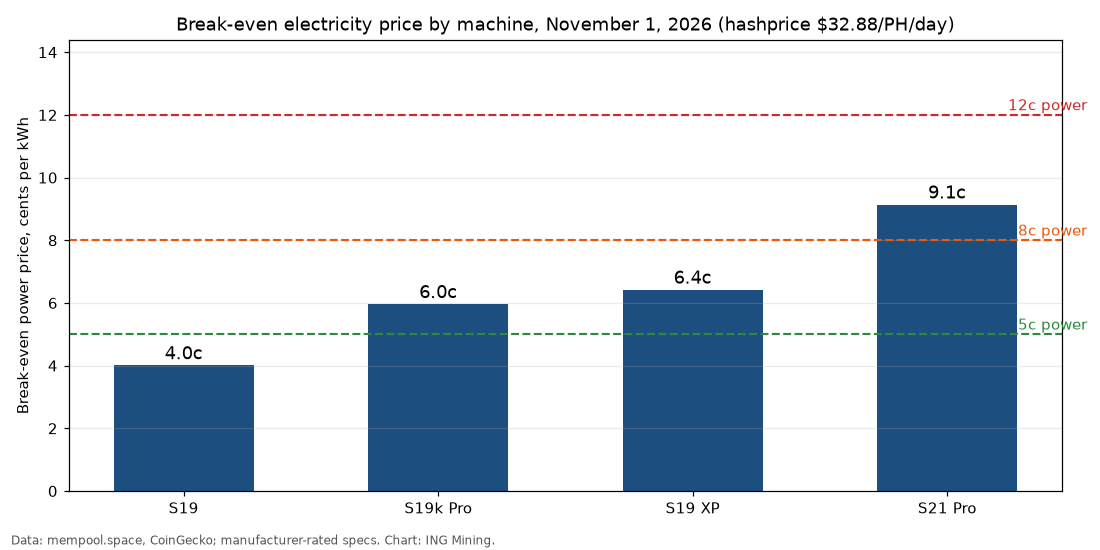
Here is the live maths on November 1. Bitcoin is $77,683 and the network is 1068 EH/s, so hashprice is about $32.88 per petahash per day. That is what one PH/s of hashing earns before power.
| Machine | 5c/kWh | 8c/kWh | 12c/kWh | Break-even |
|---|---|---|---|---|
| Antminer S19 (95 TH/s, 3250 W) | -$0.78 | -$3.12 | -$6.24 | 4.0c |
| Antminer S19k Pro (115 TH/s, 2645 W) | $0.61 | -$1.30 | -$3.84 | 6.0c |
| Antminer S19 XP (141 TH/s, 3010 W) | $1.02 | -$1.14 | -$4.03 | 6.4c |
| Antminer S21 Pro (234 TH/s, 3510 W) | $3.48 | $0.96 | -$2.41 | 9.1c |
Numbers are profit per day after electricity, at the three power prices shown. Break-even is the most you can pay per kilowatt-hour before the machine loses money. Specs are the manufacturer ratings; network data comes from mempool.space. Want to run the same numbers on a machine you can buy today? See our used ASIC miners, or buy several at once through bulk lots.
If you call Lower and bitcoin falls 10%: the break-even power price on an S19k Pro falls from 6.0 to 5.4 cents per kilowatt-hour. At 8 cents, daily profit goes from -$1.30 to -$1.67.
If you call Harder and hashrate rises 5%: the break-even power price on an S19k Pro falls from 6.0 to 5.7 cents per kilowatt-hour. At 8 cents, daily profit goes from -$1.30 to -$1.48.
Want the full table and a daily update? Open the bitcoin mining profitability today page. For free embeds, see our bitcoin mining widgets. More games are in the ING Mining Arcade.
-Nick
ING Mining
Call the Close is a free game with no money, prizes or wagering. It is not financial advice. Crypto is volatile, and you can lose money. Please do your own research.