
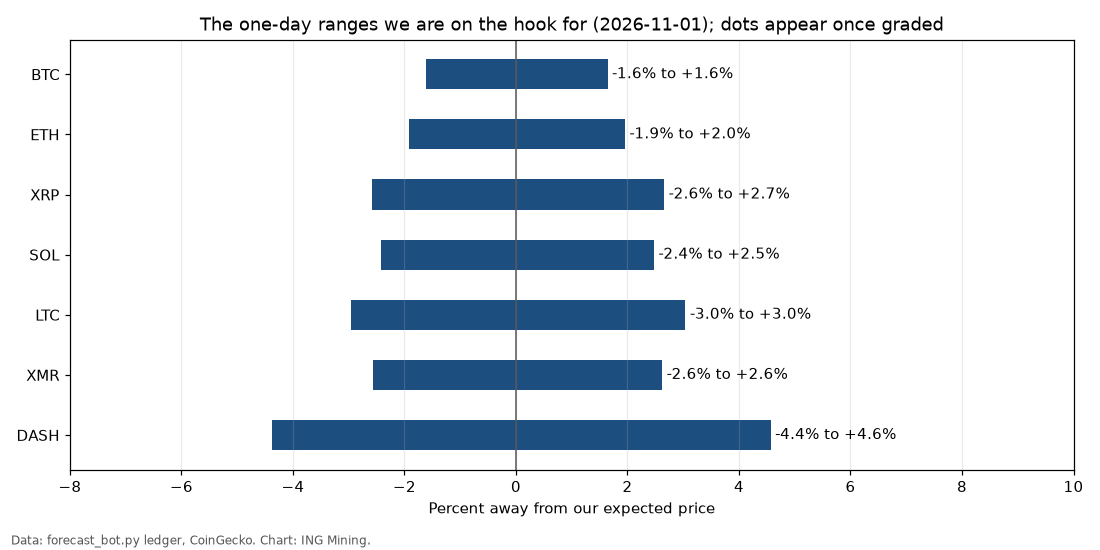
This ING Mining scorecard grades our own calls in public. As of November 1, 2026, nothing has come due yet, so the record is 0 for 0 and 8 calls are open. So that is the honest start. Also, every call below was written down before the result, and the misses will stay on the page.
How the ING Mining scorecard works
First, the daily price ranges. Each day our model gives a low, expected and high price for seven coins. The band is one standard deviation wide, so it should hold about two days in three. A hit means the next day’s CoinGecko price landed inside the band. If we hit far more than 68%, the band is too wide to be useful. On the other hand, if we hit far less, the model is too sure of itself.
Second, dated calls from our articles, such as difficulty estimates. We grade those against the real result on mempool.space. Also, a difficulty call is a hit if the real change lands within 1.0 points of what we said.
Difficulty and article calls
Open. On 2026-11-01 we said: The next difficulty adjustment (block 975,744) is basically flat, estimated at -0.7%. It is due at block 975,744, around 2026-11-12. The live estimate has since moved to -0.39%, a shift of +0.31 points, and it keeps moving with every block. We will grade it the day it lands. Here is the article.
Daily price ranges, coin by coin
We have 7 coin ranges on record from 2026-11-01, and none has a next-day price yet. So they will be filled in here on the first refresh after the day closes, hit or miss. The live versions sit on our Bitcoin price prediction page, updated daily.
Why a miss costs a miner money
A wrong price call is annoying. A wrong difficulty call changes your margin, because difficulty sets how much bitcoin each terahash earns. So we price our own errors in dollars. Therefore, the scorecard shows the cost as well as the miss. Here is the live hashprice table, then what a three percent jump in network hashrate would do.
Miner Math: what the scorecard means for your machine
Here is the live maths on November 1. Bitcoin is $77,717 and the network is 1067 EH/s, so hashprice is about $32.93 per petahash per day. That is what one PH/s of hashing earns before power.
| Machine | 5c/kWh | 8c/kWh | 12c/kWh | Break-even |
|---|---|---|---|---|
| Antminer S19 (95 TH/s, 3250 W) | -$0.77 | -$3.11 | -$6.23 | 4.0c |
| Antminer S19k Pro (115 TH/s, 2645 W) | $0.61 | -$1.29 | -$3.83 | 6.0c |
| Antminer S19 XP (141 TH/s, 3010 W) | $1.03 | -$1.14 | -$4.03 | 6.4c |
| Antminer S21 Pro (234 TH/s, 3510 W) | $3.49 | $0.97 | -$2.40 | 9.1c |
Numbers are profit per day after electricity, at the three power prices shown. Break-even is the most you can pay per kilowatt-hour before the machine loses money. Specs are the manufacturer ratings; network data comes from mempool.space. Want to run the same numbers on a machine you can buy today? See our used ASIC miners, or buy several at once through bulk lots.
If the network grows 3% faster than we said: the break-even power price on an S19k Pro falls from 6.0 to 5.8 cents per kilowatt-hour. At 8 cents, daily profit goes from -$1.29 to -$1.40.
In short, a 3% miss on hashrate moves hashprice by about 3%. On a thin-margin machine that is the difference between a profit and a loss. For reference, bitcoin trades near $77,717 and the network runs near 1067 EH/s.
Where the ING Mining scorecard goes next
In other words, every refresh adds new calls and grades the old ones. Previews we publish before big dates get registered here the same day. As a result, we cannot quietly drop the ones that go badly. For the live margin maths, see our daily profitability page. If you want the machines behind the numbers, browse our ASIC miners, or read the mining economics guides. Network data comes from mempool.space.
-Nick
ING Mining
This is general information, not financial advice. Crypto is volatile, and you can lose money. Please do your own research.