
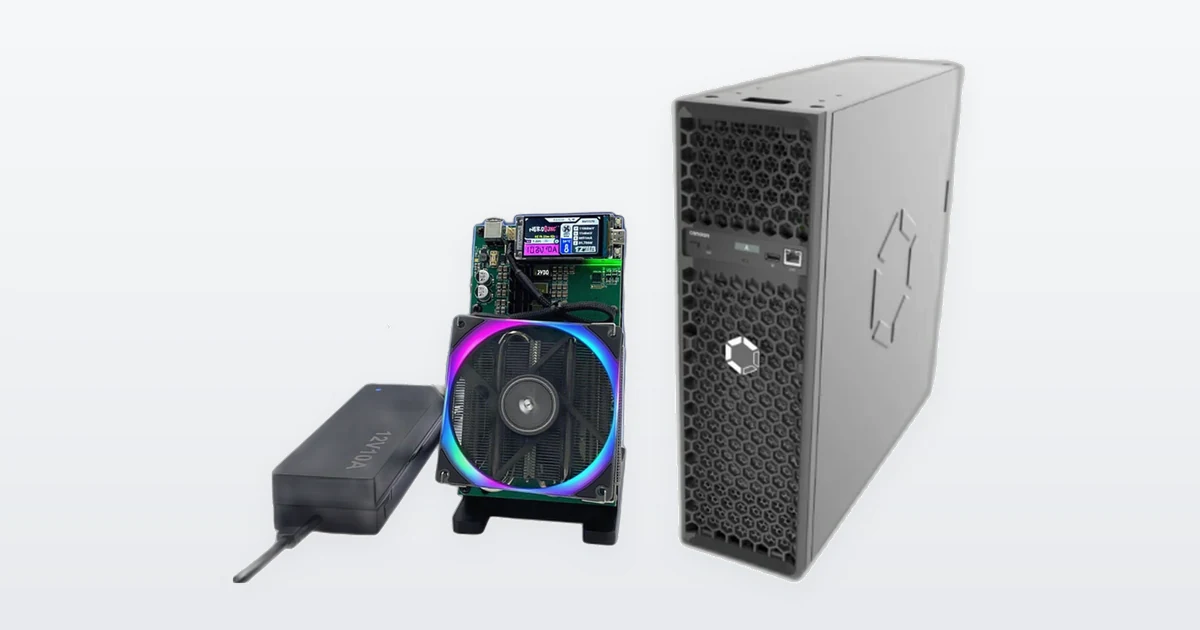
The efficiency curve is flattening, and that is the single most useful thing anyone can tell you about where mining hardware is going. Bitmain’s generations used to cut joules per terahash by a third at a time; the last three steps have been 10%, 19% and 14%. Meanwhile network difficulty has actually fallen over the past twelve months. Put those two facts together and the conclusion is not the one the industry press writes: a used machine bought today has a longer economic life than a used machine bought in 2022, not a shorter one.
Everything below is measured — the efficiency figures are read off our own listings, the difficulty history off the chain, and the break-even prices are derived from a hashprice of $31.32 per PH per day (difficulty 127.48 T, network 900 EH/s, BTC $63,072, measured 15 August 2026). All of it moves. The method is in our ASIC miner buying guide.
The efficiency curve, measured on our own shelf
Here is every SHA-256 generation we actually stock, ordered by efficiency, with the electricity price at which each one stops making money at today’s hashprice. Break-even in cents per kWh is 130.5 divided by the machine’s J/TH — that is the whole formula, and it is worth memorising because it turns a spec sheet into a purchase decision in one division.
| Generation | Efficiency | Break-even | Step vs previous |
|---|---|---|---|
| Antminer S19 95T (2020) | 34.2 J/TH | 3.82 ¢/kWh | — |
| Antminer S19k Pro (2023) | 23.0 J/TH | 5.67 ¢/kWh | −33% |
| Antminer S19 XP 141T (2022) | 21.35 J/TH | 6.11 ¢/kWh | −7% |
| Antminer S21 Pro 245T (2024) | 15.0 J/TH | 8.70 ¢/kWh | −30% |
| Antminer S21 XP 270T (2025) | 13.5 J/TH | 9.67 ¢/kWh | −10% |
| Antminer S23 318T (2026, preorder) | 11.0 J/TH | 11.86 ¢/kWh | −19% |
| Antminer S23 Hyd 580T (2026, preorder) | 9.5 J/TH | 13.74 ¢/kWh | −14% |
Read the right-hand column downwards. The jump from an S19 to an S19k Pro was worth a third of the machine’s power bill. The jump from an S21 XP to this year’s air-cooled S23 is worth 19%, and from the S23 to its hydro sibling 14%. Nobody is going to halve J/TH again, because the physics stopped allowing it: you cannot spend less energy per hash than the switching energy of the transistor doing it, and the industry is now close enough to that floor that each new node buys a smaller slice. The next generation will be judged on the same axis this one is — joules per terahash and the break-even electricity price it implies — and the gaps between generations will keep narrowing.
Difficulty went down this year, and almost nobody says so
The other half of obsolescence is the network. A machine dies when difficulty grows faster than its efficiency advantage, and for a decade that was a reliable one-way ratchet. It is not, right now, and this is the chain’s own record of the retarget at the start of each month:
| Date | Difficulty | vs today |
|---|---|---|
| August 2025 | 129.70 T | 1.7% higher than today |
| October 2025 (peak) | 155.97 T | 22% higher than today |
| February 2026 | 144.40 T | 13% higher than today |
| July 2026 | 126.23 T | 1.0% lower than today |
| 15 August 2026 | 127.48 T | — |
Difficulty is 1.7% below where it was a year ago and 18% off its October 2025 peak. The next retarget is estimated at −2.98% in about 1,121 blocks. That is a network shedding hashrate, not adding it — the machines that came off the wall between October and now were the ones whose break-even had risen above their operator’s power price, which is exactly the mechanism working as designed.
We are not going to tell you difficulty stays down. It has never stayed anywhere. The honest claim is narrower and more useful: the thing that used to make a three-year-old machine worthless has not been happening for the last year, and any hardware plan built on “difficulty rises 40% a year, so assume 18 months of life” is currently modelling a network that does not exist.
What a flattening curve does to the price of a used machine
This is where the two facts collide, and it is why we lead with used inventory rather than apologise for it. When each generation halved J/TH, the previous generation’s break-even collapsed and its resale value went with it. When a generation buys 10–19%, the old machine stays alive at any power price it was already alive at.
Concretely: a used S19k Pro at 23 J/TH breaks even at 5.67 ¢/kWh today. For that machine to become genuinely unsellable, either difficulty has to rise about 50% or hosted power has to get more expensive than 5.67 ¢ — and hosted industrial power in the 5–7 ¢ range is a real, contracted thing that thousands of machines run on right now. The S19k Pro is three years old and it is still on the correct side of that line. The 2020-vintage S19 95T at 34.2 J/TH is not: it needs 3.82 ¢/kWh, which is flare gas, curtailed wind, or a stranded hydro contract. It is still the right machine for those sites and the wrong machine everywhere else, and that is a much more specific statement than “old miners are dead”.
The buying rule that falls out of this, and the one we would give a fleet operator: buy the oldest generation whose break-even still clears your metered power price with room to spare, then spend what you saved on more units. At 6 ¢/kWh that is an S19k Pro, not an S21 Pro — you get roughly eleven of the former for the price of one of the latter, and eleven of them out-earn one of them at every rate where they are alive. The reason to pay for a new S21 Pro is a constrained site: if you have 100 A of usable service and no more, efficiency is the only way to buy hashrate. If you have power to spare and a capital limit, older is right. That trade is worked through in full in how to buy a used ASIC miner.
Hydro and immersion: 14% for the price of a water loop
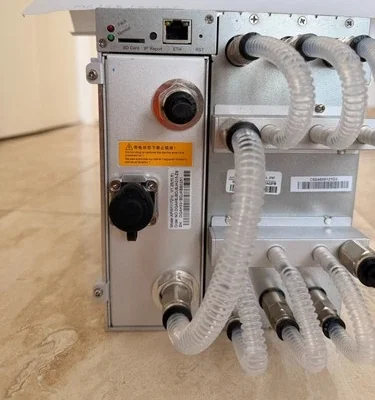
The visible change on new hardware is cooling, not silicon. The S23 Hyd 580T reaches 9.5 J/TH against the air-cooled S23’s 11.0 — a 14% efficiency gain that comes almost entirely from being able to run the chips harder while keeping junction temperature down. The same pattern shows up across the shelf: the hydro SealMiner A2 Pro Hyd variants and the whole hydro category sit a step below their air-cooled equivalents.
What the spec sheet will not tell you is that this is not a machine purchase, it is a facility purchase. A hydro miner needs a closed loop, a dry cooler or heat exchanger sized for the load, treated water, pumps with redundancy, and someone who notices when flow drops before the machine does. For a container-scale deployment that infrastructure is amortised over hundreds of units and the 14% is straightforwardly worth having. For anyone under about ten machines, the water loop costs more than the efficiency saves, and the honest answer is to buy air-cooled and spend the difference on units. We sell both and we will say so on the phone.
Immersion sits in the same category — a real efficiency and longevity gain, and a real dielectric-fluid, tank and heat-rejection project. It earns its place at scale and nowhere else.
The risks that are not on the spec sheet
Preorder risk. The S23 line is a preorder — a January batch, not stock in a warehouse in Texas. Money down for hardware that ships months later is a bet on both the manufacturer’s schedule and on the coin price at delivery, and it is the single most common way an operator ends up owning a machine whose break-even no longer clears their power price. We list preorders in their own Bitmain preorder category precisely so nobody confuses them with something we can ship this week. Ask us what is actually on the floor before you plan around a date.
Firmware and tunes. Braiins OS and VNish can genuinely improve J/TH by undervolting, and every tuned figure we publish is measured rather than quoted from the vendor. But a tune is not free efficiency: it trades hashrate for power, it voids what warranty a used machine has, and a badly tuned fleet fails in ways that look like hardware faults. Where we list a tuned figure — the S19k Pro’s ~130 TH/s VNish tune, for instance — the stock figure is on the same page.
Parts, and how long a generation stays repairable. This is the quiet one. An S19-family hashboard is a commodity; there is a deep secondhand market and the BM1398 chip is everywhere. A board for a niche or brand-new machine is not, and a repairable diagnosis you cannot source a part for is a dead machine. Buying one generation behind the front usually means buying into the deepest parts market there is, which is another argument the efficiency table does not make on its own. Our parts compatibility guide has the fitment detail, and why mining hardware fails covers what actually breaks.
Residual value. Efficiency sets the floor under a used machine’s price, so a flattening curve is the strongest argument for used hardware there has been in years — but it also means the market is thinner in both directions. If you plan to resell a fleet in 24 months, price that on today’s break-even ladder rather than on a hoped-for shortage.
And the ladder is not a price. Break-even tells you which machines stay alive; what a buyer pays is set by whoever is bidding that week, and the two numbers come apart badly. Cleaned against completed eBay sales, the same S19 XP silicon runs $2.31 per terahash at full power and $14.75 derated for a 120 V home conversion — 6.4× for the same box with most of its chips turned down — while the raw keyword average across 1,743 “Antminer S19” records is $685.43 against a cleaned median of $325.50 for a full-spec XP. That is why there is no $/TH column above: what the same silicon actually sells for per terahash works through the whole sample. If you are modelling a fleet exit in 24 months, model the medians, not the ladder.
What we would buy today, by power price
Positions, not options. At today’s $31.32 hashprice:
- Under 4 ¢/kWh — buy the oldest tested S19s you can get in volume. At 34.2 J/TH they are alive, they are cheap per terahash by a wide margin, and their parts are everywhere. This is the flare-gas and stranded-hydro case, and it is the one place a used lot beats everything.
- 4–6 ¢/kWh — S19k Pro at 23 J/TH, in lots. It clears 5.67 ¢ and it is the deepest, most liquid used market in Bitcoin mining.
- 6–8.5 ¢/kWh — S19 XP or S21 Pro territory. Above about 6 ¢ the older fleet’s margin gets thin enough that the newer machine’s efficiency pays for its price inside two years.
- Above 9 ¢/kWh — only the current generation is alive at all, and above 13.74 ¢ nothing we sell is. At the US residential average of 18.44 ¢/kWh (EIA, May 2026) there is no machine on this page that earns money, and no firmware tune closes a gap that size. That is the honest answer and hosting is the honest alternative.
Frequently Asked Questions
Is mining hardware still getting dramatically more efficient?
No, and that is the important change. On our own shelf the step from an S19 to an S19k Pro was −33% J/TH and from an S19k Pro to an S21 Pro −30%, but the last three steps have been −10% (S21 Pro to S21 XP), −19% (S21 XP to S23 air) and −14% (S23 air to S23 hydro). Silicon is close enough to the switching-energy floor that each new generation buys a smaller slice, so the gap between the newest machine and a three-year-old one is narrowing every cycle.
Does a flattening efficiency curve make used miners a better or worse buy?
Better, clearly. A used machine dies when its break-even electricity price falls below what you pay, and break-even only moves when efficiency or hashprice moves. When each generation halved J/TH the previous one collapsed in value within about eighteen months; when a generation buys 10–19%, a three-year-old S19k Pro at 23 J/TH still breaks even at 5.67 ¢/kWh, which is inside the range of real hosted industrial power.
Has Bitcoin mining difficulty gone up or down in the last year?
Down. Difficulty was 129.70 T in August 2025, peaked at 155.97 T in October 2025 and stands at 127.48 T on 15 August 2026 — 1.7% below a year ago and 18% off the peak, with the next retarget estimated at −2.98%. It has never stayed anywhere for long, so do not plan on it continuing, but any model assuming 40% annual difficulty growth is currently describing a network that does not exist.
Is a hydro-cooled miner worth it?
At scale, yes; under about ten machines, no. The hydro S23 reaches 9.5 J/TH against the air-cooled version’s 11.0, a 14% gain. That efficiency is real, but it requires a closed loop, a dry cooler sized for the load, treated water, redundant pumps and monitoring. Amortised across a container that is cheap; across five machines the loop costs more than the electricity it saves.
What efficiency do I need for my electricity price?
Divide 130.5 by your power price in cents per kWh and you get the J/TH you need at today’s $31.32 hashprice. At 6 ¢/kWh that is 21.75 J/TH, so an S19k Pro at 23 J/TH is marginal and an S19 XP at 21.35 J/TH clears. At 10 ¢/kWh you need 13.05 J/TH, which is this year’s hardware only. Re-run it with the hashprice on the day you buy.
More on where the hardware is going
- why mining hardware fails
- Mining Hardware Lifespan – How It Impacts Profitability
- Mining Profitability Explained: Key Metrics and Pitfalls
- 7 Effective Ways to Maximize Mining Profit for Miners
The machines these numbers get run against
The machines these numbers actually get run against:
- Used Antminer S19k Pro 120TH Bitcoin Miner – VNish 130TH Tune
- Lot of 10 Used Bitmain Antminer S19k Pro 115TH/s Miners – Tested, Braiins OS, PSUs Included
- Canaan Avalon Q 90T Home Bitcoin Miner – New, 110–240V, 45–65 dB
More in Bitcoin miner, or the full ASIC miner inventory. Timing the purchase is its own research problem — there is a deep-learning framework for exactly that question, and it reaches the same conclusion we do about protocol-driven revenue cycles.